By Mari Adams
East Boise County, ID – November 30, 2025
In the rugged terrain of East Boise County, where vast distances and spotty cell coverage can transform minutes into hours during a medical crisis, innovative technology is proving to be a literal lifesaver. The East Boise County EMS District is pioneering a transformative upgrade to ambulance operations by integrating advanced Zoll cardiac monitors with SpaceX’s Starlink satellite internet. This combination, sparked by a successful grant and a hands-on trial, empowers crews to deliver faster, more precise care to patients facing life-threatening cardiac events, such as STEMI heart attacks.
Last year, thanks to the exceptional grant-writing efforts of Assistant Chief, the district secured funding to purchase two state-of-the-art Zoll cardiac monitors, funded by FEMA’s Assistance to Firefighters Grant program. These devices enable crews to capture real-time vital signs, continuously monitor heart rhythms, and perform 12-lead electrocardiograms (EKGs) directly in the field. For patients experiencing chest pain or a heart attack, where rapid intervention is essential, the monitors allow EMTs to identify emergencies swiftly and share critical data with hospitals and Air Medical teams before the patient even arrives at the facility. In the first year the monitors were in service, multiple lives were saved.
The 12-lead EKG, a diagnostic tool that maps the heart’s electrical activity, is particularly vital for detecting STEMI (ST-elevation myocardial infarction) heart attacks, which require immediate catheterization. Yet, until recently, transmission posed a significant hurdle. Even with the monitors on hand, crews often struggled to send EKGs to hospitals in a timely manner. In a heart attack scenario, EMTs can capture the EKG in moments, but hospitals cannot activate the cardiac catheterization (cath) lab, the specialized unit for emergency interventions, until they receive and verify the data. That delay can spell the difference between reversible damage and irreversible harm, especially when the nearest facility is 1 hour to 2.5 hours away, in good weather. Without instant transmission, crews were essentially racing against the clock with one hand tied behind their back.
Previously, transmitting EKGs from remote areas of Boise County was fraught with challenges due to unreliable or often non-existent cell coverage. EMTs frequently had to drive to locations with available Wi-Fi, adding delays of up to an hour. In cardiac emergencies, such setbacks can have devastating consequences. Enter the Starlink trial: This satellite-based broadband service delivers high-speed internet even in the most isolated spots, circumventing the limitations of cellular networks and sporadic hotspots. Heart attack data must reach the hospital in minutes, not after the ambulance has traversed miles of rough terrain.
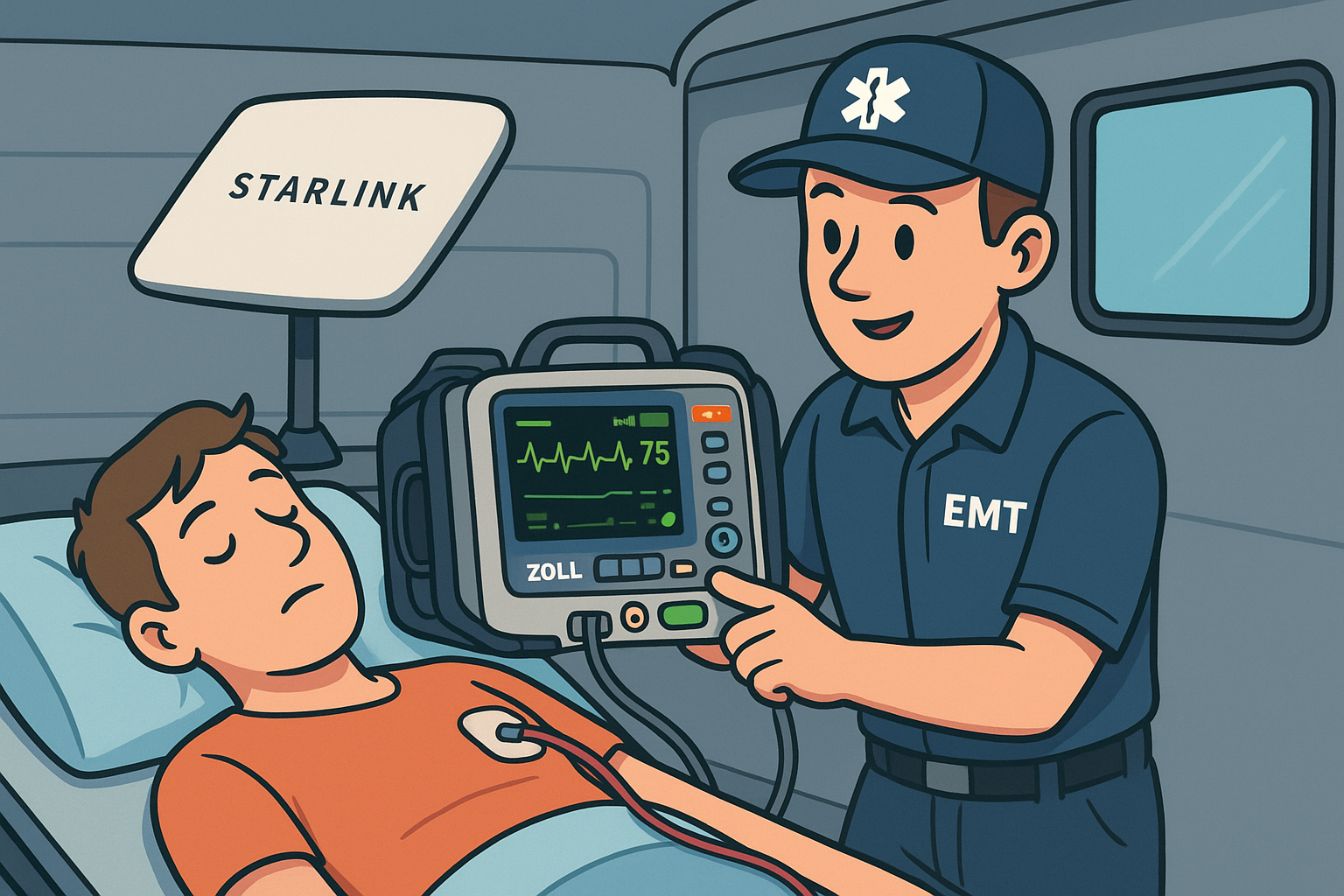
The initiative began as a simple experiment, connecting the a personal Starlink device to a Zoll monitor during a shift. The results were swift and compelling. Within a few days, the experiment was put to the test during two separate heart attack responses. In both instances, East Boise County EMS crews transmitted 12-lead EKGs to the hospital before AirMed helicopter crews landed on scene, providing the aircrew with immediate readings for seamless coordination. Armed with the pre-arrival EKG data, the hospital activated the cath lab upon the aircrew’s confirmation call. Patients were rushed into treatment upon arrival, bypassing the emergency room, with procedures underway without delay, to save their lives.
These technologies, Zoll monitors and Starlink, represent a true game-changer in Boise County. By delivering EKGs ahead of time, crews enable hospitals to analyze the data, prepare the Cath-lab, and ready stents or other interventions. For AirMed transports, instant vital sharing minimizes handoff errors and accelerates the chain of survival.
The trial’s impact resonated widely. Inspired by its life-saving potential in a region where rural isolation heightens risks, a donor contributed a dedicated Starlink unit. Demonstrating strong commitment, East Boise County EMS District commissioners approved the purchase of an additional mini Starlink device to pair with the second Zoll monitor, ensuring fleet redundancy.
With the hardware secured, the district is now prioritizing activation by obtaining service plans for the systems. Once funding is obtained and systems become operational, comprehensive crew training and outcome tracking will further optimize the process. This isn’t merely an upgrade; it’s a lifeline for our community.
Spanning 1,300 square miles of challenging topography, East Boise County EMS District responds to approximately 450 calls annually. Initiatives like this reflect a broader commitment to technology-driven rural healthcare, where every second is irreplaceable. In emergencies, time is tissue. Starlink is reclaiming those vital minutes, allowing the district to deliver cutting-edge care to every patient, regardless of location. The synergy of Zoll monitors and Starlink gives hospitals and Air Medical teams a critical head start, ensuring life-saving interventions begin without delay.
At present, the district operates five ambulances but has only two Zoll monitors, meaning they are currently assigned to the two primary response rigs. The long-term goal is to acquire three additional monitors so that every ambulance and the command vehicle, regardless of which corner of the 1,300-square-mile district it is stationed in, has immediate access to this life-saving diagnostic capability. Having a Zoll monitor on every rig would ensure that no patient, no matter how remote their location, is denied the highest standard of cardiac assessment and rapid transmission that can literally mean the difference between life and death.